
Experimenting with colours and techniques is part of the fun of painting with watercolours.
In this project, spattering, lifting-out and blotting are used to create the effect of light dancing on moving water and waves breaking on the shoreline.
You will need
- A 300gsm (140lb) sheet of NOT paper
- 2B pencil
- Paints: ultramarine blue; cerulean blue; yellow ochre; sap green; burnt umber; burnt sienna; Payne’s grey
- Brushes: Nos.12, 6, 4 and 3 round-headed; 19mm (¾in) and 7mm (¼in) flat-headed
- Gum arabic
- Natural sponge
- Stiff card
- 2 jars of water
- Palette
- Tissues
- Cotton buds
Painting is a wonderfully rewarding
hobby, and anyone can do it.
Watercolour paints are readily available and easy to use and with a few brushes and a little imagination you can set about creating your own masterpieces. Slightly textured paper (known as NOT paper) is the most commonly used, and acid-free papers don’t go so yellow with age. Thickness is indicated by weight, and paper under 300gsm (140lb) is liable to bubble or warp unless previously stretched.
You’ll probably find watercolour to be much more attainable than you thought. One way to discover various tried and tested techniques is to follow a step-by-step project. The one described here takes a beach photograph for inspiration (above). The artist also made a sketch of the scene while on location (below). The basic painting is set out in layered washes. The water, foam and shingle are developed by working into the layers – blotting, scraping, re-wetting and spattering. Wet washes can be dabbed with a sponge or scraped with card to achieve the desired effect.
Dry washes can be lightened using stripes of clean water. The paint dissolves into the water and the pigment migrates to the edges of the newly wet areas, creating bands of lighter colour. The striped effect is enhanced if you blot the wet stripes. Spatter a dry wash with water for a speckled effect.
 Capture the mood To create an image that is more than a copy of the scene, start by simplifying the forms, looking for interesting shapes and patterns. As the painting evolves, pay less attention to the photograph and use the marks you have already made. As you move away from the original subject, the painting becomes less literal, more personal and more creative. Here the artist has experimented to find a way of achieving a particular effect.
The hint of fields and hedges on the headland, and the two figures and dog on the beach, give a sense of scale and recession, and create a focus.
 1 Using the 2B pencil, make a basic outline drawing to plot the main elements of the landscape.
 2 Mix ultramarine blue and cerulean blue, and, using the No.12 brush, lay the wash for the sky, leaving the white of the paper to stand for the clouds. Add more water and take the wash down over the headland. Add yellow ochre to the mix and apply this colour over the water, using the same brush. Dab the edge of the cloud with damp sponge to soften it. Sweep a damp brush across the lower sky and headland to thin the wash, leaving a pale film of colour.
3 Cut a piece of stiff card about 3cm (1¼in) wide to make a blunt spatula. While the wash is still wet, pull the card vertically down the paper to remove parallel wavy strips of wash. These lighter bands suggest the waves surging on to the shoreline. Work into the edge of the cloud with a moist brush to soften it even more.
 4 Use a mix of sap green, burnt umber and Payne’s grey for the headland (No.6 brush). Use yellow ochre mixed with a little burnt umber for the beach area. Darken with more burnt umber and Payne’s grey and apply along the base of the headland. Mix a darker ultramarine/cerulean/yellow ochre wash by adding more of each. Add a drop of gum arabic to increase the paint’s gloss. Apply this colour over the sea (No.6 brush), taking it around the silhouette of the breakwater, and pulling it down the sheet in parallel ribbons, leaving slivers of the base colour showing through. Leave to dry.
 5 Darken the sea colour by adding ultramarine and burnt sienna and use this mix to paint the shadow of the headland. Using the small No.3 brush, lay parallel lines to suggest the wavelets on the water’s surface. These should be narrow and close together because they are in the distance. Load the No.12 brush with the same dark wash and take broad strands of this colour down the paper.
 6 Wet the No.3 brush and, starting near the horizon, lay narrow, horizontal bands of water. This causes the paint to open up gradually, producing stripes of lighter colour. They should be close together near the horizon. Make broader marks that are wider apart as you move forward to create a sense of recession from the foreground towards the horizon. Change to the No.12 brush near the bottom of the picture. Apply the water freely so it floods and one band runs into another. Lay the bands so the paint gradually opens up to create interesting textures and patterns.
 7 Mix a wash of burnt sienna and yellow ochre and use the No.4 brush to lay this on to the beach below the groyne. Use the tip of the brush to dot more colour on to the wash to suggest the shingle. Leave to dry.
 8 Load the No.3 brush with water, hold it over the paper and tap it with your forefinger to spatter droplets of water on to the beach. Then spatter wash on to the same area. Use a cotton bud to lift some of the re-wetted wash, creating very light areas to suggest lumps of chalk.
 9 Mix raw umber and Payne’s grey and, with the 7mm (¼in) flat brush, paint the uprights and planks of the breakwater. Vary the amount of Payne’s grey in the mix to create a variety of tones. Leave to dry. Then wet the edge of a piece of stiff card, and apply to the breakwater to create a wet line. Re-wet the card and repeat to create parallel wet lines. Blot with tissue to lift the colour.
 10 Wet the 19mm (¾in) flat brush and work into the white water breaking over the breakwater, creating flame-like shapes. Use plenty of water to dissolve the washes around the white paper – don’t blot it but allow the dissolved paint to flow into the white area, creating softly graduated tones. If you like, suggest fields on the headland and two figures and a dog on the beach.
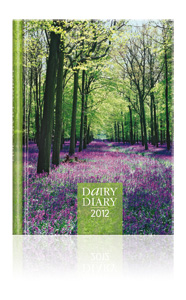
Article taken from Dairy Diary 2012.

 As I am often inspired by the local artist in my library I thought I would share some tips on watercolour painting from the Dairy Diary.
 Follow us on Twitter
 Become a fan
 Meal planning and using up leftovers seems to have fallen by the wayside and we have begun to waste food – one of my pet hates! I am sure I am not the only working mum to feel like this.


 Dairy Diary Chat