News

British Egg Week 2012

Take a Box of Eggs, Dairy Cookbook

It’s British Egg Week this week and what better time to launch our fabulous new cookbook – Take a Box of Eggs?!

Take a Box of Eggs is the latest edition in the hugely popular Dairy Cookbook Series, and features more than 100 irresistible recipes using ‘nature’s own convenience food’.
Take a Box of Eggs, Dairy CookbookThe new hard-back book is packed with dishes for every occasion, from quick and easy snacks, tasty budget dishes, and hearty family meals, to heavenly bakes and delectable desserts.

Featuring stunning photography throughout, Take a Box of Eggs shares many of the values people have come to expect from the Dairy Cookbook series, including triple-tested recipes, accessible ingredients, simple instructions and full nutritional information.

This edition also has a new format, meaning it lies flat and stays open on the kitchen worktop. It even has QR codes throughout, which provide a handy shopping list of ingredients for each recipe.

Lucy Knox, recipe writer, says “We have created a cookbook that people will want to turn to time and time again. Its practical format makes it easy to use and it is crammed with inspirational – and sometimes surprising – recipes that are suitable for both the novice cook and the culinary expert. For the Dairy Cookbook, eggs tick all the right boxes – they’re nutritious, cheap, readily available and extremely versatile.

Take a Box of Eggs with QR codes for instant shopping lists

QR codes for instant shopping lists

“So whether you’re in a hurry, looking to cook on a budget, or want to impress, it’s amazing how many easy, nutritional dishes you can prepare using eggs as a base ingredient.” 

First published in 1968, Dairy cookbooks are widely recognised as some of the most reliable recipe books ever written. Over 30 million copies have been sold worldwide, making it one of the most successful cookbook series in history.

So what are you waiting for? Buy a copy – it’s the new essential for every kitchen!

And to tantalise your tastebuds, here are a couple of recipes from the book for you to try.
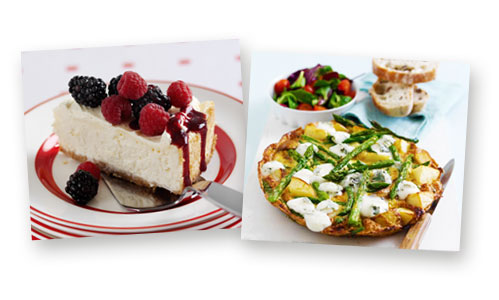
Amrican Cheesecake and Frittata receipes

Baked American Cheesecake and Potato,Thyme & Blue Cheese Frittata.

3 fabulous home-made skincare treatments

3 fabulous home-made skincare treatments

Beauty on a budget: homemade hand treatments that don’t cost a packet.

With household budgets under increasing strain, it’s hard to justify spending a small fortune on expensive skincare treatments.

But thankfully there is a way to pamper yourself without breaking the bank.

The latest edition of Britain’s best-selling diary series contains some homemade hand treatments that are made from everyday ingredients.

“We use our hands all day, every day, and since they are constantly exposed, and work so hard, it’s not surprising that they tend to show signs of ageing before other parts of the body. Looking after them well prevents this from happening but it’s all too easy to neglect them.

“However, just a few minutes’ attention with these homemade products, supplemented with exercise, can go some way towards giving your hands the care they need to stave off the effects of everyday life.”

Here are three quick and simple hand treatments you can make yourself.

Strawberry Hand Scrub
This is a treatment to smooth and soften your hands. Strawberries contain a natural fruit acid that aids exfoliation and boosts the freshness of your skin.
• Strawberries 8-10
• Olive Oil 2 tbsp
• Coarse Sea Salt 1 tsp
Mash all the ingredients together until they form a paste. Rub this into your hands and leave for two minutes. Rinse off well with cool water and pat your hands dry with a soft towel. Moisturise the skin well. Use the scrub once a week or whenever your hands are feeling rough or dry.

Rose Handcream
Moisture-retaining glycerine (available from chemists) keeps your hands nourished, while rose water is a gentle tonic for skin.
• Glycerin 6 tbsp
• Rose Water 150ml (1/4 pint)
• Vitamin E Oil 1 tbsp, optional
Pour all the ingredients into an empty screw-top bottle, or a tub with a secure but easily removable lid, and shake well to mix. Store in a cool place. Apply a 10 pence-sized blob as often as needed. Shake well before use.

Almond Hand Softener
Almond oil is packed with antioxidants, which means that as well as softening skin, it fights the effects of ageing. Honey is both moisturising and antiseptic, helping to rehydrate and cleanse the skin.
• Almond Oil 2 tsp
• Clear Honey 1 tsp
• Cotton Gloves
Mix together the almond oil and honey and massage on to your hands. It’s best to leave this lotion on overnight, so wear cotton gloves while you sleep (or you could use cotton socks instead). In the morning rinse off the softener with warm water and pat your hands dry.

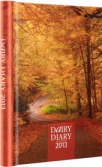
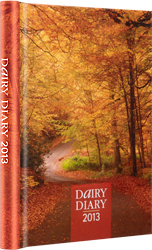
Dairy Diary 2013The 2013 Dairy Diary is priced at £6.99
and is available from:

  • Visit www.dairydiary.co.uk
  • Call 0845 948128
  • If you have a milkman, simply put
    a note out with your empties.

Dairy Diary 2013 now available

The Sairy Diary 2013 is now available

BRITAIN’S best selling hard-back diary is back for a 31st year – and it’s even better than its predecessors.

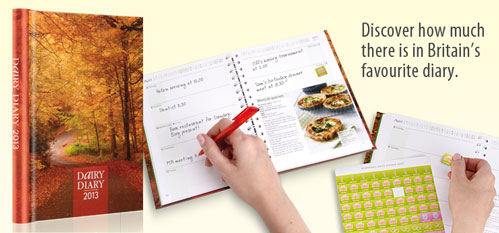
Described as a ‘compendium of practical information’, the 2013 Dairy Diary is packed with useful hints and tips, making it the essential book for running any busy home.

A wide selection of mouth-watering recipesSplit into seven easy-to-use sections, it’s full of sage advice on a vast array of subjects, from stain removal to homemade hand treatments, and childhood illnesses to looking after precious metals. It also contains a beginner’s guide to pilates, and helpful tips on how to create a bird friendly garden.

The 2013 diary also features a wide selection of mouth watering recipes to suit all occasions, from quick and simple soups and snacks, to classic staples such as beef casserole and fish pie, and delectable desserts like Hogmanay Tart and Irish Whiskey Cake.

Executive Editor, Nick Rowe, says:

“The Dairy Diary has become an essential companion over the years and this latest version, our 31st edition, is the most comprehensive one we have produced so far.

“It’s packed with recipes and practical hints and tips, which makes it an excellent point of reference.

“This edition contains some inspiring articles on a host of different topics, from bread making to home made hand treatments, and how to transform your garden into a haven for birds.”

The Dairy Diary is the best week-to-view diary you can buy

The Dairy Diary 2013 comes with memorable date stickers

The first Dairy Diary was produced by the Milk Marketing Board in 1982. In 2001 it was taken over by Eaglemoss Consumer Publications and has become Britain’s best-selling home diary series, selling over 20 million copies.

Dairy Diary Set

The Dairy Diary Set offers amazing value for moneyThe Dairy Diary is also available in the 2013 Dairy Diary Set, which contains:

  • Dairy Diary 2013
  • Notepad for messages and shopping lists
  • Designer pencil
  • Easy-use pen
  • Notes holder with pen and pencil storage

Perfect for managing any busy life – and a great value gift too at just £8.99!

How to order

The 2013 Dairy Diary is priced at £6.99 and the Dairy Diary Set is priced at £8.99.

  • Visit www.dairydiary.co.uk
  • Call 0845 948128
  • If you have a milkman, simply put a note out with your empties.

Family fun for the school holidays

Family fun for the school holidays

It’s National Family Week this week, which is very apt given that it’s the summer holidays and many of us will spend lots of time with our children.

As a mum of three under-fives, I now know what a rollercoaster ride it is being a parent! BC (before children), I imagined life to be a whirlwind of harmonious activities; from playing games to spotting wildlife to making crafts.

Yes, of course, you can do these things, but in reality you may have one child who just wants to play with his cars and another who wants to eat the paint!

So, here I have suggested some ideas for the summer holidays that you and your children MAY want to try. But if they don’t want to, stay chilled (if possible!) and enjoy watching them do their chosen activity instead (even if they have been pushing trains around a track for the past 4 weeks!)

Under 5s

  • Create a very simple treasure hunt at home with one word cards to follow, such as table, chair and toybox.
  • Food packets and tubes can be used for plenty of activities: your child can sort them into different shapes and sizes; the tubes and packaging can be used as building bricks, and painted in different colours.
  • Make a themed collage (by colour, season or transport, for example) with pictures cut from magazines. If the children are very young, cut the pictures out yourself and allow them to stick.
  • Make pasta necklaces by painting individual pasta shapes, such as penne. Allow to dry, thread on to string and tie.
  • Imprint rubbing can be intriguing for little ones. Place a piece of paper over a patterned object, such as a coin, leaf or shell, and then rub over the top with a crayon. Cut a potato in half and carve a simple pattern into the flesh. Make several of these for your child to cover in paint and print the shapes on a piece of paper.
  • Paint can be used in all sorts of ways. Cut a butterfly shape from a piece of paper. Ask your child to paint a pattern on one side then fold in half while still wet to see the pattern mirrored.
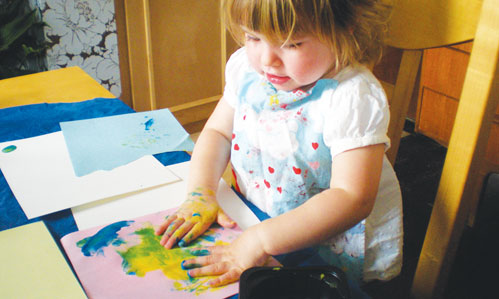
  • With paint, you can also create butterflies from two children’s hand prints with a blob of paint in the middle. Sponge painting is also great fun, or try drawing patterns with wax crayon and painting over the top.
  • Use the playdough recipe (below) to create models, make patterns and cut into shapes. Baking equipment is ideal for use with playdough.
  • Encourage an interest in food at an early age by making chocolate and rice crispy cakes together, or simple flapjacks with butter, oats and syrup.
  • Play some lively music and dance with your child. Get him/ her to mirror your movements, count or clap to the beat, or waltz with your child standing on your feet.
  • Let’s pretend – choose an animal and make the relevant noises and movements. Choose contrasting animals, such as a tiny mouse and huge elephant.
  • Ask your child to clap out the rhythm of his/her name and clap along, or clap to the beat of a song. Make a simple shaker by sealing dried rice or pasta in a tub to shake along to the music.
  • At the start of the day choose one letter from the alphabet and see how many things beginning with that letter your child can spot throughout the day. Paint a picture or create a picture collage of some of those things at the end of the day.
  • Go for a short walk and collect natural objects, such as pinecones, pebbles and feathers. With glue, paint and paper, make little creatures from your finds. You could also try a ‘colour walk’ and ask your child to point out all the yellow items he or she sees, for example.

5-12 year olds

  • Family fun for the school holidaysMake a calendar or clock. For a clock, decorate a paper plate then paint on numbers and secure cardboard hands with a paper fastener. To create a calendar, choose month-appropriate pictures from a magazine and stick them on to 12 sheets of card or paper. Print out dates from the computer or write them down. Hole-punch each sheet and secure together with string. Both these craft projects will encourage your child to learn about time, days and months.
  • Use food packets to play shop. Your child can use scales to weigh items, stickers for pricing and change to learn about money and counting. Or your child could make a money box, and learn how to save. Create a model village by painting windows, doors and flowers onto packets.
  • To make an impressive mosaic picture, draw a large, simple design (such as flowers) on a piece of paper, cut small squares from coloured paper or magazines and use one colour to fill each section of the design.
  • Fingerprint characters are fun. Simply make lots of fingerprint marks with paint on a sheet of paper and allow to dry. Then make faces, monsters, animals and bugs by adding features/hair/legs/arms/tails with a black pen.
  • Create finger puppets – ask your child to draw animal or people characters on a piece of paper. Cut them out and glue a loop of paper to the back.
  • For paper weaving, cut long thin strips from coloured paper or magazines. Then take a larger piece of paper and cut strips almost but not quite to the top so it’s fringed. Weave each complete paper strip horizontally under and over the fringed strips. Trim the sides and secure at the back with tape.
  • Encourage your child to get involved in all (safe) food preparation to foster his/her interest in food. Choose a simple recipe (try Hot chocella on p155 or Yogurt cake on p141) and follow it together.
  • Throw a dice and draw a funny animal. Each number represents a body part (write these down first), take it in turns to throw and draw part of the beast. See what bizarre creatures you can create together.
  • Using either your clothes or jumble-sale finds, play dressing up and role play. You could pretend to be pop stars, play their music and sing with a hairbrush ‘microphone’ while dressed up. Face paints or make-up are good for this activity, too.
  • Hold a treasure hunt throughout the house and garden. Make around ten simple clues, such as ‘Your next clue is very cold’ (the clue’s hidden in the fridge) and hide them in appropriate places. The treasure can be a small toy or a home-made cake. The fun is in the hunt, not the prize. You could also encourage your child to write clues for you to hunt.
  • Make a family photo album. When you go out, take photos of teddy, or a favourite soft toy, in various places. Then put the photos in an album with other family members for your child to keep. You could also create a family tree together.
  • Children often get bored while out walking. Make a countryside stroll more fun with a ‘spotter’s list’. Write a list of plants, birds and creatures with tick boxes and a small reward. For example, blackbird 2p, kingfisher 50p. Your child will then have something for his/her moneybox at the end of the walk.
  • Poetic artwork – go for a walk and jot down things you do, see, smell, touch and hear. For example, bees buzzing, the scent of lavender, warm sunshine, green grass, a thrush singing, steep hill. When you get home, encourage your child to write them all down in different coloured pens/crayons on a piece of paper.


How to make play doughHow to make Playdough

Plain flour 1 cup
Water 1 cup
Vegetable oil 1tbsp
Cream of tartar 2tsp
Salt ½ cup
Food colouring a few drops

1 Place all ingredients in a pan on a low heat.

2 Stir continuously until mixture thickens to a firm dough texture.

3 Store in an airtight container and keep away from pets.


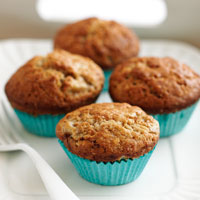
Banana and Cinnamon muffins recipeBanana & Cinnamon Muffins

Any why not bake these delicious
muffins with your little cooks too?

This recipe can be found in our
fabulous new cookbook
Take a Box of Eggs.


Coffee Culture

Coffee shops are springing up on high streets all over the country, which may seem to indicate that we are drinking a lot more coffee – truth is we are actually drinking a lot more milk.

Coffee Culture 2013The latte, as its names suggests, is mainly hot flavoured milk, and the choice of flavouring can be comfortingly familiar or enticingly revolutionary!

Coffee houses have made a spectacular comeback in the 21st century. Gone are the days of steamy hot-water machines, formica-topped tables and juke boxes in the corner. Instead, you find comfortable chairs, a choice of cup sizes and a whole new range of flavours, such as gingerbread and banoffee.

The latest incarnation of coffee-house culture made its way to these shores from Italy and America, and the Brits have embraced it wholeheartedly, enthusiastically adapting it to suit.

According to research carried out for Taylerson’s Coffee Syrups, amaretto is particularly popular with the over 40s whereas ginger is taking over from the ever-popular vanilla and hazelnut.

Caramel is another favourite, and during the festive season everyone gets carried away with novelty flavours, such as Christmas cake. Seasonal changes make drinks more fun, and some coffees work hot or cold. Spiced Chai flavourcoffee, for example, is a lovely warming drink in the depths of winter, and yet is popular iced in the hottest summer.

Making a frappe

Mocha, mint choc, strawberry and banana all make a great iced coffee drink, or frappe (pronounced ‘frapay’), which is a kind of milkshake for grownups. Baristas – the people who prepare the coffee (from the Italian for ‘bartender’) – often use frappes as their ‘signature’ drink, and occasionally include alcohol to make it even more interesting. Making a frappe couldn’t be simpler. All you need is some crushed ice and about 10ml of flavoured syrup to 200ml of cold milk. Whizz them all together in a blender and seconds later it’s ready. Pour into a tall, frosted glass and you’ve got a long, cool, refreshing drink. Top it off with chocolate flakes, cream or even mini marshmallows.

For coffee suggestions see the 2013 Dairy Diary.

Cappuccino CakesAnd for coffee lovers, here
are some scrummy little
Cappuccino Cakes.
A taster of the gorgeous
recipes to be found in the
2013 Dairy Diary.


Follow us on Twitter! Follow us on Twitter

Follow us on Facebook! Become a fan

Dairy Diary 2013 now available!

Dairy Diary 2013

Every year I am astonished at how early people start to ask for the following year’s Dairy Diary.

This year, I think we might have the record for the earliest, with a request in May!

We know that it’s Britain’s best-loved diary, so maybe I shouldn’t be so surprised. Since its first edition back in 1982, it has sold well over 20 million copies!

Described as a ‘compendium of practical information’, the 2013 Dairy Diary is packed with useful hints and tips, making it the essential book for running any busy home. Split into seven easy-to-use sections, it’s full of sage advice on a vast array of subjects, from stain removal to homemade hand treatments, and childhood illnesses to looking after precious metals. It also contains a beginner’s guide to pilates, and helpful tips on how to create a bird friendly garden.

Mouth-watering recipes

The 2013 diary also features a wide selection of mouth-watering recipes to suit all occasions, from quick and simple soups and snacks, to classic staples such as beef casserole and fish pie, and delectable desserts like Hogmanay Tart and Irish Whiskey Cake.

Executive Editor, Nick Rowe, says:

“The Dairy Diary has become an essential companion over the years and this latest version, our 31st edition, is the most comprehensive one we have produced so far.
“It’s packed with recipes and practical hints and tips, which makes it an excellent point of reference.
“This edition contains some inspiring articles on a host of different topics, from bread making to homemade hand treatments, and how to transform your garden into a haven for birds.”

It’s simple to order:

  • www.dairydiary.co.uk to order online.
  • Ring 0845 0948 128 to order over the phone (Mon-Fri, 9am-8pm).
  • Or put a note out with your empties to order from your milkman.

Cherry Biscuits recipeEnjoy this Cherry Biscuits recipe
from the 2013 Dairy Diary .

Just a taster of the fantastic
recipes inside.

Follow us on Twitter! Follow us on Twitter

Follow us on Facebook! Become a fan

1 43 44 45 67