News

National Allotments Week

National Allotments Week

Throughout my childhood, my Grandad kept an allotment. It was a pretty ramshackle affair with a patched up homemade ‘shed’ and a rickety path made out of bits of tile that Grandad procured on his travels.

He lived through two world wars and as a consequence was very much a make-do-and-mend sort of person.

Never was he mean with money, but he didn’t believe in waste, and recycled – in the old-fashioned sense of the word – or mended everything himself. He even glued together the little Fimo figures I made as a child, and proudly displayed them on the mantelpiece long after I had reached adulthood.

As a result, everything in his home, garden and allotment had a slightly eccentric feel. I remember sitting on the step to his shed watching him pull up weeds or ‘squit’ as his used to call them and chatting about my day at school. The allotment would never have won awards for beauty, or even reached the status of ‘shabby chic’, but the produce grown on there was delicious.

My favourite was his beetroot,
which he pickled in big re-used
glass jars and sliced with cheese
to make sandwiches, with his
gorgeous home-baked bread.

Enough of my nostalgia, this week is National Allotments Week, created to help celebrate and protect the allotment, not so that I can reminisce.

This is what the Allotment Society reveals about the event:

National Allotments Week exists to highlight how brilliant allotments are. They not only bring communities together, provide space for growing and fresh air for individuals and families alike, but they benefit wildlife and help to keep our cities breathing. Unfortunately allotments are under threat.

Each year the National Allotment Society supports hundreds of allotment holders who are fighting off proposals from landlords to dispose of their allotment land. Did you know that if all the allotments in the UK were added together, they would cover 58 Hyde Parks? Just imagine what would happen to our ecosystem if this land was lost to developers – billions of insects and animals would be wiped out, the risk of flooding in towns and cities would increase and air pollution would intensify – not to mention the detrimental impact it would have on people’s health and wellbeing.

So to celebrate this year’s National Allotments Week, we are asking everyone to make a fuss about allotments by either holding or attending a ‘Party on the Plot’ – because if we don’t shout about them, then who will.

See National Allotments Week website for more details.


Pickled BeetrootHere’s the Dairy Diary
recipe for Pickled Beetroot.

It tastes as good, or almost
as good, as my Grandad’s.


Follow us on Twitter! Follow us on Twitter

Follow us on Facebook! Become a fan

Olympic Games: 10 quirky facts

Top 10 Olympic Games Quirky Facts

Are you enjoying the Olympic Games?

But did you know these fascinating 10 Olympic facts?

1 Britain is the only country to have won a gold medal in every one of the modern summer Olympics – and in 1908, GB’s tally was 56!

2 Club swinging, cricket, croquet, golf, lacrosse, live pigeon shooting, motor boating, polo, rope climbing, rugby and tug-of-war are among discontinued Olympic sports. Tennis, abandoned in 1924, was restored in 1988.

3 The 1948 London Olympics were the first to be televised and 500,000 watched the opening ceremony (in black and white, of course).

4 Art competitions (Architecture, Sculpture, Painting and Graphic Art, Literature and Muscial Composition) were included in the 1948 London Olympics for the last time.

5 In 1956, the Games took place in Melbourne but the equestrian events were held earlier in the year in Stockholm, because of Australia’s strict quarantine regulations.

6 A host city, rather than country, is chosen as a venue for the Games, usually seven years in advance.

7 Gold medals were first awarded in 1908, and made of solid gold. After 1912, they were made of silver and coated in gold. The medals are specially designed by the host city’s organising committee, but the obverse side always includes an image of Nike, the goddess of victory.

8 In Amsterdam, 1928, at the end of the women’s 800m the competitors were seen to be ‘weary and overwrought’ and the event was deemed to be too dangerous for women. It was not staged again until 1960.

9 The Paralympic Games were first held in the same city as the Olympics in 1960, and used the same facilities from 1988. They attract increasing numbers of athletes and spectators, and are watched by millions worldwide.

10 After 1988, all professional athletes were deemed eligible for the Olympic Games (except boxing).


Let us know how you scored.


Facts taken from Dairy Diary 2012.

Follow us on Twitter! Follow us on Twitter

Follow us on Facebook! Become a fan

National Parks Week

Lake District / Cumbria - Wast Water

Ok, so our weather may be atrocious and some of our preferences and politics questionable, but I am fiercely proud of Britain.

Where else can you experience such varied and beautiful topography in such a small space; see such stunning architecture; experience genuine history and enjoy so much culture?

National Parks are amongst our genuine treasures, and places of which we can be justifiably proud. They are areas of protected countryside that everyone can visit, and where people live, work and shape the landscape.

The UK’s 15 National Parks are part of a global family of over 113,000 protected areas, covering 149 million square kilometres or 6% of the Earth’s surface.

There are 10 National Parks in England, 3 in Wales and 2 in Scotland:

■ England – Dartmoor, Exmoor, Lake District, New Forest, Northumberland, North York Moors, Peak District, the Yorkshire Dales, the South Downs and the Broads which has equivalent status to a National Park.

■ Wales – Brecon Beacons, Pembrokeshire Coast and Snowdonia

■ Scotland – Cairngorms and Loch Lomond and the Trossachs.

Each park is so distinctly different and spectacular in its own way, it would be very difficult to choose a favourite (although I do delight in the towering crags of the Lakes and the delicacy of the wild flowers on the Pembrokeshire coast.)

This year’s National Parks Week is a celebration of our beautiful winning landscapes that have inspired mountaineers, sailors, cyclists, runners and Olympic athletes to aim higher and train harder.

Sebastian Coe, now Lord Coe and the man in charge of our 2012 Olympic Games, was brought up in Sheffield and used to train in the Peak District National Park before going on to win Olympic gold medals in Moscow (1980) and Los Angeles (1984) and many other medals in a glittering athletic career.

The hope is that a visit to a National Park will inspire everyone to get fit and active too!
There are activities and events for all ages and abilities in all areas of Britain. See http://www.nationalparks.gov.uk/visiting/events.htm for more details.


Fat Rascals recipeAnd after all that exertion, you’ll need
some sustenance. Try these Fat Rascals,
which originate from one of the
National Parks; the North
Yorkshire Moors.

Recipe taken from Around Britain Dairy Cookbook.


P.S. The main image is Wast Water, Lake District.

Follow us on Twitter! Follow us on Twitter

Follow us on Facebook! Become a fan

Summer Food Festivals

The Big Cheese

I love food festivals and I love fireworks and luckily this coming weekend, there’s an event that combines both!

Set in the shadows of one of Europe’s largest castles the town of Caerphilly comes to life as people of all ages come to The Big Cheese.

This festival is an extravaganza of street entertainers, living history encampments, music, dance, traditional funfair, folk dancing, falconry, fire eating, minstrels, troubadours and of course, cheese! http://your.caerphilly.gov.uk/bigcheese/home-page

It’s also British Food
fortnight, which
encourages us to
‘buy British’.

And how could we resist with such a wealth of fantastic local producers exhibiting their wares. There’s always so much to whet the appetite that it’s best to limit the money you take to a food fair or you will be dragging a suitcase-full of goodies home with you!

Here some more forthcoming foodie events (hopefully there’s one local to you). Enjoy!

Feast East
28 July, Linton, Cambridgeshire. Taste of Anglia’s 18th food and drink festival.
http://www.feasteast.co.uk/

Clitheroe Food Festival
4 August, Clitheroe, Lancashire. A day fully packed with glorious, quality Lancashire produce and the Ribble Valley’s top chefs.
http://www.clitheroefoodfestival.co.uk/

Tastefest Food & Drink Festival
18-19 August, Goudhurst, Kent. TasteFest will be celebrating food and drink from across the South East.
http://tastefest.nmgl.co.uk/

Isle of Wight Garlic Festival
18-19 August, Newchurch, Isle of Wight. A vast array of eats, sights and sounds to suit all tastes and ages.
http://www.garlic-festival.co.uk/

Bolton Food Festival
24-27 August, Bolton, Lancashire. Cookery theatre and a speciality market offering great food and drink produce.
http://www.boltonfoodanddrinkfestival.com/

Big Onion Festival
25 August, Elveden, Suffolk.
Showcasing a host of local food and drink producers from the Suffolk area.
www.bigonionfestival.com/

Newlyn Fish Festival
27 August, Newlyn, Cornwall. A stunning display of locally caught fish and seafood in this showcase of the best the region has to offer.
www.newlynfishfestival.org.uk/

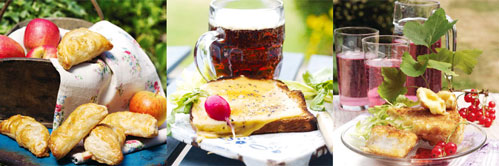
Celebrate cheesy British produce with one of these tasty snacks.

British Food Fortnight recipes

Cheese and Apple Parcels

Gloucester Cheese and Ale

Brie with Redcurrant Jelly

Happy Cherry Day!

National Cherry Day

Cherries are my all-time favourite fruit. I find them rather addictive though, and when I open a punnet and start to nibble, it is very difficult to stop!

Cherries are rich in antioxidants, which are supposed to help with sleep and boost memory. The cherry also has anti-inflammatory properties.

National Cherry Day gives me
the perfect excuse to indulge,
and of course they are much
healthier than my other vice
– chocolate!

The Romans first brought cherries to the UK and some even say that ancient roads can be traced from the spots where marching Romans spat out their stones and caused a new tree to grow!

By the 16th century Kent had emerged as the principal cherry county and by the 17th century colonists were taking the cherry to New England.

However, over the last fifty years we’ve seen a decline in our cherry orchards, which means that we now import around 95% of all cherries! The main goal of National Cherry Day is to maintain our traditional orchards. If everyone eats one home-grown cherry each, the future of British cherries will be looking up in no time!

.
Cherry Yogurt IceTry this irresistible
Cherry Yogurt Ice

Recipe taken from
Hearty & Healthy
Dairy Cookbook
.


Follow us on Twitter! Follow us on Twitter

Follow us on Facebook! Become a fan

Your Holiday Checklist


We have just enjoyed a wonderful family holiday in Mallorca, which really helped me to relax and forget the stresses and strains of everyday life.

However, I felt more stressed than ever in the week before I went, trying to remember everything I had to do and pack.

Packing for a family holiday

This year, I have vowed to make a holiday packing list, laminate it and keep it in the suitcase so I don’t have to try and think about it each and every year.

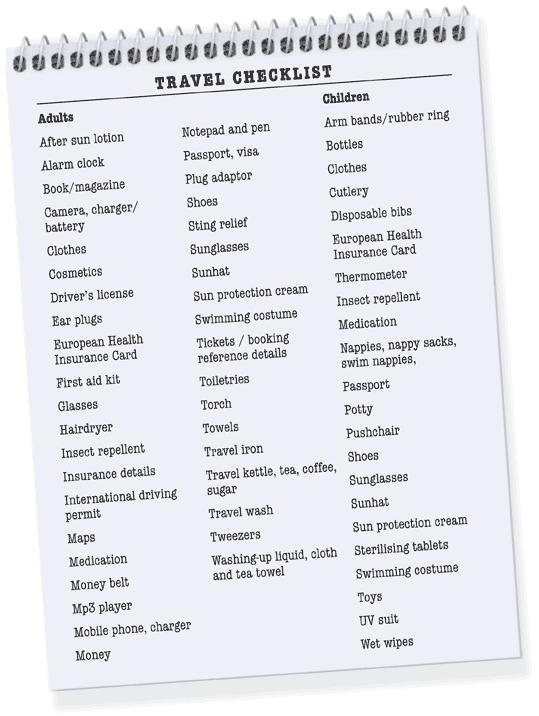
To save you the job, here is the Dairy Diary’s list on what to remember and what to take:

Before you go

  • Check all passports, EHIC cards are up to date and you have any necessary visas
  • Book pets into kennels
  • Order currency
  • Book airport transfer or parking
  • Research your destination; where to visit, what to prepare for; what to avoid
  • Take out travel insurance (and leave a copy with a friend or relative)
  • Book your transfers/car hire at your destination

Dairy Diary Holiday Checklist

Have a wonderful time!

Shrewsbury BiscuitsAnd something to take on the plane/bus/car…

Shrewsbury Biscuits
from AroundBritain
Dairy Cookbook
.

CLICK HERE FOR RECIPE

Follow us on Twitter! Follow us on Twitter

Follow us on Facebook! Become a fan

1 44 45 46 67