.
Easy homegrown tomatoes for British Tomato Week – no greenhouse required!
I can still conjure up the sweetly acidic fragrance of ripening tomatoes in my Grandad’s rickety old greenhouse.

.
I can still conjure up the sweetly acidic fragrance of ripening tomatoes in my Grandad’s rickety old greenhouse.

.
Busy adj (busier, busiest) 1 having a great deal to do 2 currently occupied with an activity.
Sound familiar?
If, like me, you have a to-do list as long as your arm then getting a good routine is essential for staying on top of things, and a few simple tricks to speed up daily chores can make all the difference.

.
We’re five days into May and the British asparagus season is in full swing – hurrah!
I adore asparagus. It’s so tender, and its delicate flavour lends itself to many recipes, though it’s also wonderful on its own, lightly steamed and sprinkled with sea salt.

.
This week I would like to share with you my favourite spring recipes.
These snacks, meals and bakes use gorgeous seasonal ingredients, are simple to create and taste delicious.
Which will become your favourite?
#tripletested
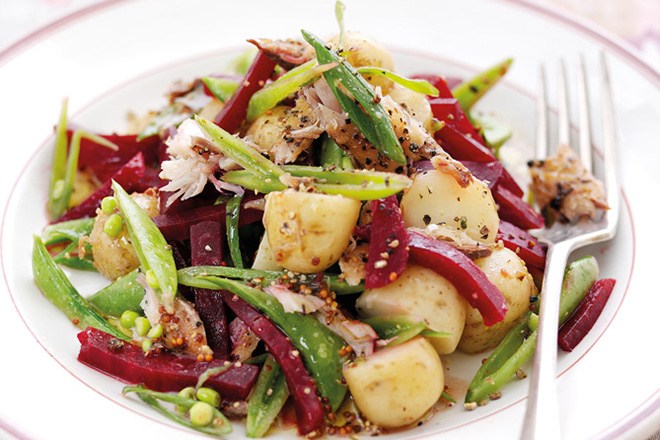
Time 25 mins
Serves 4
Calories 494
Fat 36 of which 7g is saturated
New potatoes 450g (1lb), scrubbed and halved
Olive oil 6 tbsp
Red wine vinegar 3 tbsp
Caster sugar 2 tsp
Grainy mustard 2 tsp
Sugarsnap peas 100g (3½oz), shredded
Spring onions ½ bunch, thinly sliced
Smoked peppered mackerel 250g (9oz), skinned and broken into chunks
Cooked beetroot 200g (7oz), cut into matchsticks
1 Cook potatoes in simmering water for 10-15 minutes, until tender. Drain well.
2 Meanwhile, mix oil, vinegar, sugar and mustard together.
3 Put sugarsnap peas in a salad bowl with spring onions, mackerel and beetroot.
4 Add potatoes to the bowl with dressing and fold gently together.
A Dairy Diary recipe.
#tripletested #recipes

.
For events near you visit http://www.nationalgardeningweek.org.uk/Events.aspx.
My two favourite British Gardens
are Bodnant in North Wales and
Coleton Fishacre in Devon.
My own plot may only be a fraction of the size but these wonderful places provide so much inspiration to create a serene and stunning outdoor space.
I must admit my gardening strategy up to now has been: visit garden centre, choose something pretty, throw it in anywhere, hope it survives. For obvious reasons, this technique does not always work!
Inspired by this feature in the 2015 Dairy Diary, this year I am going to be much more scientific and have produce proper plan. I’m going to sketch out the design first using inspiration from Pinterest (see the Dairy Diary Gorgeous Gardens board) and then work out where the sunny/shady spots are and the soil type before deciding on the planting scheme.
Using the Dairy Diary guide, it’s pretty simple really!

One of the challenges of gardening is to get the best out of your entire plot, whatever the differing types of soil or changing light conditions, and however sheltered or exposed all or part of it may be. If you can get the basics right, you’re on your way.
Have you ever wondered why some plants thrive in the garden and others seem to give up, no matter how much attention you lavish on them? One reason may be that the location just doesn’t suit. While some plants are adaptable and tolerant, others are extremely fussy, so although you may be eager to get down and dirty among the hardy annuals and the weeds (they always seem to survive!), first things first – before lifting a trowel or opening a nursery catalogue, cast an eye over the soil and light levels throughout your garden. Take note of the differences and think about how to take advantage of, or combat, them. Not every section of the garden may be subject to the same exposure, or shade. Plan according to the specific conditions of each area.
Soil
If you can identify the type of soil you have in your garden, you can choose plants that have a fair chance of succeeding. See the box on page 39 for a guide to soil types, and take a good look at what’s under your feet. For instance, chalky soil may be obvious if it contains chalky particles, but sandy soil isn’t yellow, so don’t be fooled by initial appearances! And bear in mind that although it’s a good idea to try to improve your soil – with organic matter, for instance, and adding grit to clay will improve drainage – it is often a heartbreaking waste of time to try to alter it fundamentally. Much better to adapt and work with what you’ve got.
“Adding plenty of organic matter
before planting will help, whatever
the soil type.”
Acid or alkaline?
The acidity or alkalinity of your soil affects the nutrients contained in it, and so is hugely influential in whether the plants you have chosen will thrive or struggle. An acid-loving plant, such as a camellia, will not do well in alkaline soil and may not even survive, and likewise an alkaline-loving plant, such as a wallflower, will not do well in acidic soil. However, although some plants grow in acid soil only, and some in alkaline, there are degrees – many have just a slight preference and can adapt to soils that do not veer too much one way or the other.
So how can you tell what sort of soil you have? The technical way to express it is as a pH number and you can buy easy-to-use pH testing kits in garden centres. Neutral – the level at which most nutrients are available – is pH 7. A higher number shows an alkaline soil, lower is acidic. Most plants do well in soil with a pH of 6 to 7.
When testing for pH, it’s a good idea to take samples from different parts of the garden, because it’s quite possible for soil to change within a small area, especially in urban gardens or where building or landscaping work has previously taken place.
Lime haters
These include rhododendrons, azaleas, camellias, summer-flowering heathers, pernettya, the calico bush, some ferns, blueberry and dogwood. They are known as ericaceous plants, and in a chalky soil their leaves tend to turn yellow and chances are they will die. If you have set your heart on one of the lime-haters but your soil is alkaline and limey, try planting it in a suitably sized container filled with ericaceous compost (this has a pH of between 5 and 6). Remember to keep the soil moist – ericaceous plants are often shallow-rooted and tend to dry out easily.
Light and heat
Whether your garden is north or south-facing, or somewhere in between, will dictate what areas are in full or partial shade, or full sun, and when. Hosta, cyclamen and magnolia do well in dappled shade while mesembryanthemum just loves the sun.
Buildings, walls, trees, hedges and any other shade-throwing obstacles located nearby will also have an effect, of course, on both light and temperature. Sunny walls, for instance, reflect heat, and the soil at their base may be dry. Plants grown here will need a lot of watering, especially if the soil is sandy or chalky and thus free-draining. Adding plenty of organic matter before planting will help, whatever the soil type, and mulching with bark chippings, gravel or pebbles helps retain water, and looks attractive.
Salt and wind
If you live by the sea, you will have to consider salt-tolerance, as well as everything else, when choosing plants – but there are plenty to choose from, and a plus point is that in coastal areas the risk of frost is much reduced.
In exposed gardens, wind can be a problem – cold in winter, warm and drying in summer, and high winds are always damaging. Trees and hedges can be used to slow down the wind, giving your plants a fighting chance of survival. As well as on the boundary, where hornbeam is a good choice, you could use bushes, such as a compact rose, within the garden to cordon off small areas where you can grow more susceptible plants, athough as a rule, it’s best to choose hardy varieties.
If your garden is exposed and by the sea, holly, blackthorn, Griselinia littoralis, hawthorn, sea buckthorn and willow are all good windbreak choices.
Alkaline lovers for clay soil
Hardy and salt-tolerant plants
Shade-loving plants
Plants for a sunny spot
Soil types
Clay: feels smooth and will roll into a sausage shape; holds nutrients and water; takes a long time to warm up in spring and bakes hard in summer, often cracking; heavy and sticky to work; mostly alkaline.
Sandy: feels gritty and falls through your fingers; drains quickly and so is low in nutrients, which are washed away by rain; light and easy to work; warms up quickly in spring; often acidic.
Silt: just about holds together in a ball but will crumble if rolled thinly and is not sticky; fertile, drains fairly well but holds more moisture than sandy soil and is easily compacted. Garden soil is not often of pure silt.
Loam: mixture of clay, sand and silt; has many variations, tending towards either clay or sand; fertile, drains well, easily worked; probably the best soil for gardens.
Chalky: lime-rich and may be light or heavy; free-draining and very alkaline.
Useful websites
#nationalgardeningweek
 Dairy Diary Chat