Author Archives for Emily Davenport, Head of Dairy Diary

About Emily Davenport, Head of Dairy Diary

Head of Dairy Diary; I'm passionate about producing high quality products that our customers will cherish. I'm also a mum of three and I enjoy cooking, walking, gardening and painting with my family, as well as printmaking (when I find the time!)

Facebook competition | Three days left to win a fabulous Breadmaker

Dairy Diary Facebook competition | Win a Breadmaker

Just a three days left to enter our Facebook sweepstake!

Fancy waking to the wonderful aroma of freshly baked bread every morning?

Well you can if you enter the
Dairy Diary sweepstake and
win this fabulous Morphy
Richards Easy Use Breadmaker.

The Morphy Richards Easy Use breadmaker is far more than just a bread machine.

It features three different loaf sizes and five different crust settings with a 12-hour delay timer so you can wake up to fresh bread every morning. Over 50 recipes are included in the instruction book, so you can make full use of the 13 different programmes to make all kinds of bread as well as pizza doughs, cakes, desserts and even jams and marmalades.

The viewing window means you can monitor the baking process without letting heat escape from the chamber, and the ergonomically designed cool-touch LCD display is safe and easy to use.

Enter the Dairy Diary Facebook sweepstake today.

Good luck.

Behind the scenes of the Dairy Diary – meet the team

Once a month, I will give you a behind the scenes look at the Dairy Diary and meet the team.

We are a small group but each one of us very different…..this month Graham, our marketing and design guru.

What is your role within Dairy Diary?
I help Nick and Emily with the Dairy Diary and Dairy Cookbook marketing strategies, and design marketing materials such as leaflets, adverts and the website. In addition, I have designed the last five Dairy Cookbooks.

What’s the best thing about working on Dairy Diary?
It’s a privilege to work on a product that has such a long heritage and is loved by so many people.

What’s the worst thing about working on Dairy Diary?
Working with food images means that it is very difficult to forget about eating. And I snack far too much! (Note to self: lock fridge door)

Tell us something we don’t know about you
I have fallen in love with live music again and will be found at The Cambridge Rock Festival in August, camping for all four days and enjoying the fabulous rock music, great food (Tibetan, Caribbean, veggie, etc) and 70 real ales!

What are your favourite things in life?
Other than my wife, kids and new puppy? Well, I love the mountains; rock climbing, walking, skiing… anything which gets me into the mountains. The more remote the better.

What is your favourite Dairy Diary or Dairy Cookbook recipe?
It has to be Ginger and Banana Sponge Pudding with Hot Toffee Sauce and served with real custard. It is so, so good; everything a pudding should be and then some.

Ginger and Banana Sponge Pudding
with Hot Toffee Sauce

If you ever need a recipe that is the
definition of comfort food – this is it!
Let it gently steam away while you
enjoy the wonderful aromas.

Recipe taken from The New Dairy Cookbook

Follow us on Twitter! Follow us on Twitter
Follow us on Facebook! Become a fan

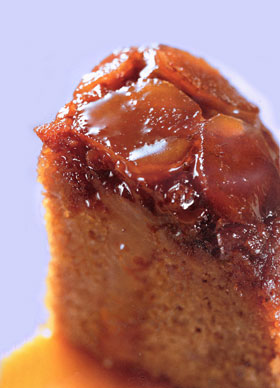
Ginger and Banana Sponge Pudding with Hot Toffee Sauce

If you ever need a recipe that is the definition of comfort food – this is it! Let it gently steam away while you enjoy the wonderful aromas.
Serves 6
Suitable for vegetarians
Suitable for freezing

Butter, 110g (40z) + extra for greasing
Light muscovado sugar, 11Og (4oz)
Eggs, 2, beaten
Vanilla extract, 1 teaspoon
Self-raising flour, 11Og (4oz) ~
Ground ginger, ½ teaspoon
Salt, pinch
Bananas, 2 medium
Milk, 2 tablespoons
Stem ginger in syrup, 4 pieces + 3 tablespoons of the syrup from the jar

Sauce:
Golden syrup, 4 tablespoons
Butter, 50g (2oz)

1 In a large mixing bowl, cream the butter and sugar together until light and fluffy. Gradually beat in the eggs, then stir in the vanilla extract.Sift in the flour, ground ginger and salt, then fold in lightly using a large metal spoon.

2 Using a fork or potato masher, mash the bananas thoroughly, then fold them into the creamed mixture with the milk.

3 Butter a 900ml (1½ pint) pudding basin. Slice the stem ginger and place it in the bottom of the basin with the 3 tablespoons of syrup from the jar. Spoon over the creamed mixture and level the surface. Cover the basin tightly with a piece of buttered foil.

4 Steam the pudding in a steamer or a large saucepan for 2 hours 15 minutes, making sure that the water does not boil dry, and topping up with boiling water as needed.

5 Allow the pudding to cool slightly whilst you make the sauce. Gently heat the syrup and butter together, then simmer for 1 minute. Remove the foil from the pudding, run a knife around the edge to loosen it, then invert onto a large plate. Serve with the sauce.

Cook’s tips
If cooking in a saucepan, the water needs to be about one-third of the way up the pudding basin.
To measure syrup, warm a metal spoon in boiling water or over a gas flame so that the syrup slides off easily.
Custard or single cream could be served with the pudding.

Recipe taken from The New Dairy Cookbook

Follow us on Twitter! Follow us on Twitter
Follow us on Facebook! Become a fan

Competition | Win a Breadmaker for National Bread Week

Competition | Win a Russell Hobbs Breadmaker

Win Win Win! A fabulous breadmaker for National Bread Week

My other half is a baker and so I am spoilt with freshly baked bread on a regular basis.

Many people shy away from making their own bread, but it can be incredibly rewarding. I have to admit though, on days when time is short (frequently!) we do turn to our breadmaker. It’s so easy and the aroma and taste you get for so little effort is fantastic.

Obviously, to eat too much of anything is not good for you, but bread really does get a bad press. In reality, one slice has only around 85 calories and less than 1g of fat. It’s usually what we put on the bread that adds the calories!

This week is National Bread Week,
so don your pinny and get baking!

Get baking for National Bread Week

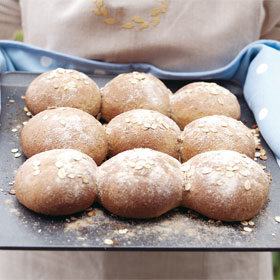
Try these fabulous Sally Lunns or Traditional Bread Rolls, both from the Around Britain Dairy Cookbook.

And for those days when time is precious…. Win a Morphy Richards Breadmaker

Enter the competition here. Good luck! 

P.S. Give your friends a chance to win too! Share this competition on Facebook (Share this : Facebook below).

Follow us on Twitter! Follow us on Twitter
Follow us on Facebook! Become a fan

Traditional homemade bread

A proven recipe for both white and wholemeal bread rolls

Traditional homemade bread recipePreparation time – 10 minutes plus soaking and proving time
Cooking time – 15 minutes
Calories per roll – 144 Kcal
Fat per roll – 3g of which saturated – 1.6g
Makes – 18 rolls
Suitable for vegetarians
Suitable for freezing

Wholemeal bread
Warm water 450ml (16fl oz)
Caster sugar 4 tsp
Traditional dried active yeast 1 tbsp
Wholemeal flour 680g (11⁄2lb), plus a little extra for sifting
Salt 2 tsp
Butter 50g (2oz)
Milk 300ml (1⁄2 pint), warm
Egg 1 large beaten with 2 tbsp milk
Oats for sifting, optional

White bread
Warm water 150ml (1⁄4 pint)
Caster sugar 4 tsp
Traditional dried active yeast 1 tbsp
Organic strong plain flour 680g (11⁄2lb)
Salt 2 tsp
Butter 50g (2oz)
Milk 300ml (1⁄2 pint), warm
Egg 1 large beaten with 2 tbsp milk
Oats for sifting, optional

1 Place 150ml (1⁄4 pint) of the warm water in a bowl or jug, add 1 tsp of the sugar and the yeast. Whisk well, then cover with cling film and leave to stand in a warm place for 15 minutes until a 5cm (2in) froth forms.

2 Meanwhile, sift the flour, remaining sugar and salt into a bowl, rub in the butter and make a well.

3 Whisk the yeast mixture and add to the flour, along with the remaining water and milk. Mix to a dough, then turn out onto a floured surface and knead until smooth and very elastic. Or mix with a dough hook in an electric mixer.

4 Cut the dough into 18 equally sized pieces and shape each one into a smooth ball. Place the balls on greased and lightly floured baking trays – well spaced apart. Loosely cover with cling film and leave to rise until doubled in size and retains an impression when lightly pressed with the tip of a finger – about 30 minutes.

5 To bake, preheat the oven to 230°C/450°F/Gas 8. The risen rolls may be sifted with flour and oats before baking, or brushed with milk or milk and beaten egg. Bake for 10–15 minutes until well risen, golden brown and sound hollow when tapped on the base. Cool on a wire rack.

Cook’s tip
The ideal temperature for the warm water is ‘blood heat’, which is when the water feels neither hot nor cold when a finger is dipped into it.

Recipe taken from Around Britain Dairy Cookbook

Follow us on Twitter! Follow us on Twitter
Follow us on Facebook! Become a fan

Sally Lunns

The story is that Sally Lunn was a refugee who travelled from France to England during the 17th century and made a living by selling these large flattish buns in Bath from her secret recipe.

Sally Lunns - large flat bunsPreparation time – 15 minutes plus 30–45 minutes proving
Cooking time – 20 minutes
Calories per roll – 602 Kcal
Fat per roll – 17g of which saturated – 8.4g
Serves – 4
Suitable for vegetarians

Strong plain flour 500g (1lb 2oz)
Fast-acting dried yeast 7g sachet
Salt 1 tsp
Eggs 2, lightly beaten
Milk 300ml (½ pint), warmed to blood heat
Butter 50g (2oz) melted

1 Tip the flour into a bowl and stir in the yeast and salt. Reserve about 1 tbsp beaten egg, then beat the rest with the milk and butter and pour into the flour mixture. Mix together well to give a soft dough. Knead the dough for about 10 minutes on a lightly floured surface until it is stretchy.

2 Preheat the oven to 220°C/425°F/Gas 7 and butter two 18cm (7in) sandwich tins.

3 Divide the dough in half and shape each half into a flattish round ball and place in the sandwich tins. Cover with oiled cling film and leave them in a warm place until the dough has doubled in size.

4 Brush the reserved egg over the top of the loaves to glaze them. Bake the loaves towards the top of the oven for 15–20 minutes, until they have risen and are a golden colour. When lifted out of the tins, the loaves should sound hollow when tapped on the base – if they don’t, return them to the oven and cook for a little longer.

5 Remove the loaves from the oven and transfer to a wire rack. Serve them warm or cold, split in half and served as they are or lightly toasted, or fill them with your favourite savoury combination and eat like a sandwich.

Cook’s tip
If you want really glossy and deeper colour crusts, the buns may be brushed with a second coating of extra egg glaze halfway through the cooking process.

Recipe taken from Around Britain Dairy Cookbook

Follow us on Twitter! Follow us on Twitter
Follow us on Facebook! Become a fan