Author Archives for Emily Davenport, Head of Dairy Diary

About Emily Davenport, Head of Dairy Diary

Head of Dairy Diary; I'm passionate about producing high quality products that our customers will cherish. I'm also a mum of three and I enjoy cooking, walking, gardening and painting with my family, as well as printmaking (when I find the time!)

Pickled Beetroot recipe

You either hate it or love it. But you have love the colour!

Pickled BeetrootMakes 1.25–1.5kg (2½–3lb)
Time 2 hours, plus infusion
13 calories per 25g (1oz)
0g fat
Suitable for vegetarians

Fresh, uncooked beetroot 1.25–1.5kg (2½–3lb)
Cinnamon 5cm (2in) piece
Mace 3 pieces
Whole allspice 1 tsp
Whole peppercorns Bristol Blend 1 tsp
Large dried chillies 3
Whole cloves 5
Caster sugar 2 tbsp
Distilled malt vinegar 5% acidity, 700ml (1¼ pints)

1 Wash beetroot well and cut off stalks to within 2.5cm (1in) of each beetroot. Place beetroot in a large saucepan, cover with cold water and bring to boil. Reduce heat, partially cover and cook gently for 1–1½ hours until cooked. Drain and leave to cool overnight.

2 Place all spices in a stainless steel or unchipped enamel pan, add sugar and 300ml (½ pint) vinegar and bring to boil. Remove from heat, cover and leave overnight.

3 Peel cooked beetroot and cut into slices 5mm (1⁄4in) thick. Loosely layer in clean jars. 4 Stir remaining vinegar into spiced vinegar, then pour into jars – including spices – making sure beetroot is well covered. Cover with lids and store in a cool, dry, airy place.

A Dairy Diary recipe

Follow us on Twitter! Follow us on Twitter

Follow us on Facebook! Become a fan

Olympic Games: 10 quirky facts

Top 10 Olympic Games Quirky Facts

Are you enjoying the Olympic Games?

But did you know these fascinating 10 Olympic facts?

1 Britain is the only country to have won a gold medal in every one of the modern summer Olympics – and in 1908, GB’s tally was 56!

2 Club swinging, cricket, croquet, golf, lacrosse, live pigeon shooting, motor boating, polo, rope climbing, rugby and tug-of-war are among discontinued Olympic sports. Tennis, abandoned in 1924, was restored in 1988.

3 The 1948 London Olympics were the first to be televised and 500,000 watched the opening ceremony (in black and white, of course).

4 Art competitions (Architecture, Sculpture, Painting and Graphic Art, Literature and Muscial Composition) were included in the 1948 London Olympics for the last time.

5 In 1956, the Games took place in Melbourne but the equestrian events were held earlier in the year in Stockholm, because of Australia’s strict quarantine regulations.

6 A host city, rather than country, is chosen as a venue for the Games, usually seven years in advance.

7 Gold medals were first awarded in 1908, and made of solid gold. After 1912, they were made of silver and coated in gold. The medals are specially designed by the host city’s organising committee, but the obverse side always includes an image of Nike, the goddess of victory.

8 In Amsterdam, 1928, at the end of the women’s 800m the competitors were seen to be ‘weary and overwrought’ and the event was deemed to be too dangerous for women. It was not staged again until 1960.

9 The Paralympic Games were first held in the same city as the Olympics in 1960, and used the same facilities from 1988. They attract increasing numbers of athletes and spectators, and are watched by millions worldwide.

10 After 1988, all professional athletes were deemed eligible for the Olympic Games (except boxing).


Let us know how you scored.


Facts taken from Dairy Diary 2012.

Follow us on Twitter! Follow us on Twitter

Follow us on Facebook! Become a fan

National Parks Week

Lake District / Cumbria - Wast Water

Ok, so our weather may be atrocious and some of our preferences and politics questionable, but I am fiercely proud of Britain.

Where else can you experience such varied and beautiful topography in such a small space; see such stunning architecture; experience genuine history and enjoy so much culture?

National Parks are amongst our genuine treasures, and places of which we can be justifiably proud. They are areas of protected countryside that everyone can visit, and where people live, work and shape the landscape.

The UK’s 15 National Parks are part of a global family of over 113,000 protected areas, covering 149 million square kilometres or 6% of the Earth’s surface.

There are 10 National Parks in England, 3 in Wales and 2 in Scotland:

■ England – Dartmoor, Exmoor, Lake District, New Forest, Northumberland, North York Moors, Peak District, the Yorkshire Dales, the South Downs and the Broads which has equivalent status to a National Park.

■ Wales – Brecon Beacons, Pembrokeshire Coast and Snowdonia

■ Scotland – Cairngorms and Loch Lomond and the Trossachs.

Each park is so distinctly different and spectacular in its own way, it would be very difficult to choose a favourite (although I do delight in the towering crags of the Lakes and the delicacy of the wild flowers on the Pembrokeshire coast.)

This year’s National Parks Week is a celebration of our beautiful winning landscapes that have inspired mountaineers, sailors, cyclists, runners and Olympic athletes to aim higher and train harder.

Sebastian Coe, now Lord Coe and the man in charge of our 2012 Olympic Games, was brought up in Sheffield and used to train in the Peak District National Park before going on to win Olympic gold medals in Moscow (1980) and Los Angeles (1984) and many other medals in a glittering athletic career.

The hope is that a visit to a National Park will inspire everyone to get fit and active too!
There are activities and events for all ages and abilities in all areas of Britain. See http://www.nationalparks.gov.uk/visiting/events.htm for more details.


Fat Rascals recipeAnd after all that exertion, you’ll need
some sustenance. Try these Fat Rascals,
which originate from one of the
National Parks; the North
Yorkshire Moors.

Recipe taken from Around Britain Dairy Cookbook.


P.S. The main image is Wast Water, Lake District.

Follow us on Twitter! Follow us on Twitter

Follow us on Facebook! Become a fan

Fat Rascals

Fat Rascals recipeThere is lots of history behind these biscuits, and they may originally have been cooked on open turf or peat fires on Whitby Moor. 

Preparation time – 10 minutes
Cooking time – 18 minutes
Calories per biscuit – 200 Kcal
Fat per biscuit – 9g of which saturated – 5.8g
Makes – 10
Suitable for vegetarians

Plain flour 250g (9oz)
Salt pinch
Butter 110g (4oz)
Currants 50g (2oz)
Light muscovado sugar 2 tbsp
Milk 3–4 tbsp
Caster sugar for sprinkling

1 Preheat the oven to 200°C/400°F/Gas 6. Butter a baking sheet.

2 Sift the flour into a bowl and add the salt. Rub in the butter, then stir in the currants and sugar. Add the milk and bind to form a dough. Knead the dough lightly on a floured surface and then roll it out to about 1cm (1⁄2in) thick.

3 Use a 5cm (2in) cutter to cut out rounds and place them on the baking sheet. Re-roll and cut trimmings as necessary. Sprinkle caster sugar over the tops. Cook in the centre of the oven for 15–18 minutes. These will keep in an airtight container for up to three days.

Recipe taken from Around Britain Dairy Cookbook.

Summer Food Festivals

The Big Cheese

I love food festivals and I love fireworks and luckily this coming weekend, there’s an event that combines both!

Set in the shadows of one of Europe’s largest castles the town of Caerphilly comes to life as people of all ages come to The Big Cheese.

This festival is an extravaganza of street entertainers, living history encampments, music, dance, traditional funfair, folk dancing, falconry, fire eating, minstrels, troubadours and of course, cheese! http://your.caerphilly.gov.uk/bigcheese/home-page

It’s also British Food
fortnight, which
encourages us to
‘buy British’.

And how could we resist with such a wealth of fantastic local producers exhibiting their wares. There’s always so much to whet the appetite that it’s best to limit the money you take to a food fair or you will be dragging a suitcase-full of goodies home with you!

Here some more forthcoming foodie events (hopefully there’s one local to you). Enjoy!

Feast East
28 July, Linton, Cambridgeshire. Taste of Anglia’s 18th food and drink festival.
http://www.feasteast.co.uk/

Clitheroe Food Festival
4 August, Clitheroe, Lancashire. A day fully packed with glorious, quality Lancashire produce and the Ribble Valley’s top chefs.
http://www.clitheroefoodfestival.co.uk/

Tastefest Food & Drink Festival
18-19 August, Goudhurst, Kent. TasteFest will be celebrating food and drink from across the South East.
http://tastefest.nmgl.co.uk/

Isle of Wight Garlic Festival
18-19 August, Newchurch, Isle of Wight. A vast array of eats, sights and sounds to suit all tastes and ages.
http://www.garlic-festival.co.uk/

Bolton Food Festival
24-27 August, Bolton, Lancashire. Cookery theatre and a speciality market offering great food and drink produce.
http://www.boltonfoodanddrinkfestival.com/

Big Onion Festival
25 August, Elveden, Suffolk.
Showcasing a host of local food and drink producers from the Suffolk area.
www.bigonionfestival.com/

Newlyn Fish Festival
27 August, Newlyn, Cornwall. A stunning display of locally caught fish and seafood in this showcase of the best the region has to offer.
www.newlynfishfestival.org.uk/

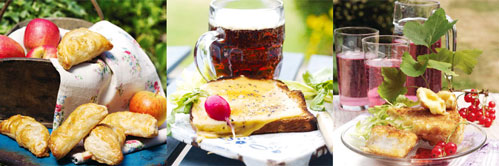
Celebrate cheesy British produce with one of these tasty snacks.

British Food Fortnight recipes

Cheese and Apple Parcels

Gloucester Cheese and Ale

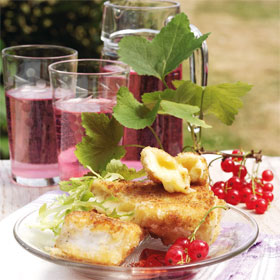
Brie with Redcurrant Jelly

Brie with Redcurrant Jelly

Brie Cheese and Redcurrant Jelly

Brie with Redcurrant Jelly

Made in Somerset, according to traditional French methods, Somerset brie is considered by many to be as fine as French brie, with its straw colour and creamy tangy flavour. Serve it coated in breadcrumbs, as a really simple, light lunch – delicious!

CLICK HERE FOR RECIPE

Recipe taken from Around Britain Dairy Cookbook

Follow us on Twitter! Follow us on Twitter

Follow us on Facebook! Become a fan