Monthly Archives: April 2012

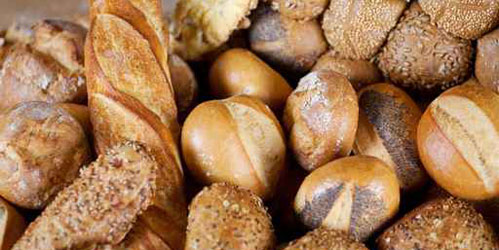
Traditional homemade bread

A proven recipe for both white and wholemeal bread rolls
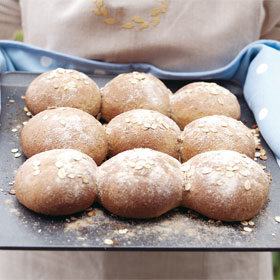
Traditional homemade bread recipePreparation time – 10 minutes plus soaking and proving time
Cooking time – 15 minutes
Calories per roll – 144 Kcal
Fat per roll – 3g of which saturated – 1.6g
Makes – 18 rolls
Suitable for vegetarians
Suitable for freezing

Wholemeal bread
Warm water 450ml (16fl oz)
Caster sugar 4 tsp
Traditional dried active yeast 1 tbsp
Wholemeal flour 680g (11⁄2lb), plus a little extra for sifting
Salt 2 tsp
Butter 50g (2oz)
Milk 300ml (1⁄2 pint), warm
Egg 1 large beaten with 2 tbsp milk
Oats for sifting, optional

White bread
Warm water 150ml (1⁄4 pint)
Caster sugar 4 tsp
Traditional dried active yeast 1 tbsp
Organic strong plain flour 680g (11⁄2lb)
Salt 2 tsp
Butter 50g (2oz)
Milk 300ml (1⁄2 pint), warm
Egg 1 large beaten with 2 tbsp milk
Oats for sifting, optional

1 Place 150ml (1⁄4 pint) of the warm water in a bowl or jug, add 1 tsp of the sugar and the yeast. Whisk well, then cover with cling film and leave to stand in a warm place for 15 minutes until a 5cm (2in) froth forms.

2 Meanwhile, sift the flour, remaining sugar and salt into a bowl, rub in the butter and make a well.

3 Whisk the yeast mixture and add to the flour, along with the remaining water and milk. Mix to a dough, then turn out onto a floured surface and knead until smooth and very elastic. Or mix with a dough hook in an electric mixer.

4 Cut the dough into 18 equally sized pieces and shape each one into a smooth ball. Place the balls on greased and lightly floured baking trays – well spaced apart. Loosely cover with cling film and leave to rise until doubled in size and retains an impression when lightly pressed with the tip of a finger – about 30 minutes.

5 To bake, preheat the oven to 230°C/450°F/Gas 8. The risen rolls may be sifted with flour and oats before baking, or brushed with milk or milk and beaten egg. Bake for 10–15 minutes until well risen, golden brown and sound hollow when tapped on the base. Cool on a wire rack.

Cook’s tip
The ideal temperature for the warm water is ‘blood heat’, which is when the water feels neither hot nor cold when a finger is dipped into it.

Recipe taken from Around Britain Dairy Cookbook

Follow us on Twitter! Follow us on Twitter
Follow us on Facebook! Become a fan

Sally Lunns

The story is that Sally Lunn was a refugee who travelled from France to England during the 17th century and made a living by selling these large flattish buns in Bath from her secret recipe.

Sally Lunns - large flat bunsPreparation time – 15 minutes plus 30–45 minutes proving
Cooking time – 20 minutes
Calories per roll – 602 Kcal
Fat per roll – 17g of which saturated – 8.4g
Serves – 4
Suitable for vegetarians

Strong plain flour 500g (1lb 2oz)
Fast-acting dried yeast 7g sachet
Salt 1 tsp
Eggs 2, lightly beaten
Milk 300ml (½ pint), warmed to blood heat
Butter 50g (2oz) melted

1 Tip the flour into a bowl and stir in the yeast and salt. Reserve about 1 tbsp beaten egg, then beat the rest with the milk and butter and pour into the flour mixture. Mix together well to give a soft dough. Knead the dough for about 10 minutes on a lightly floured surface until it is stretchy.

2 Preheat the oven to 220°C/425°F/Gas 7 and butter two 18cm (7in) sandwich tins.

3 Divide the dough in half and shape each half into a flattish round ball and place in the sandwich tins. Cover with oiled cling film and leave them in a warm place until the dough has doubled in size.

4 Brush the reserved egg over the top of the loaves to glaze them. Bake the loaves towards the top of the oven for 15–20 minutes, until they have risen and are a golden colour. When lifted out of the tins, the loaves should sound hollow when tapped on the base – if they don’t, return them to the oven and cook for a little longer.

5 Remove the loaves from the oven and transfer to a wire rack. Serve them warm or cold, split in half and served as they are or lightly toasted, or fill them with your favourite savoury combination and eat like a sandwich.

Cook’s tip
If you want really glossy and deeper colour crusts, the buns may be brushed with a second coating of extra egg glaze halfway through the cooking process.

Recipe taken from Around Britain Dairy Cookbook

Follow us on Twitter! Follow us on Twitter
Follow us on Facebook! Become a fan

Celebrate National Bread Week

Celebrate National Bread Week

Celebrate National Bread Week by baking your own bread – it’s easier than you think.

Bread has long been a principal form of food. The British museum has loaves which were baked in Egypt over 5000 years ago!

The first bakers guilds were formed in ancient Rome and baking became a respected profession with about 300 bakers in the city at the time of Christ. The Romans took baking with them as they built their empire.

In the middle ages most landlords had a bakery which was a public oven.

Bread became such an important staple in our diet that in 1202 King John introduced the first laws governing the price of bread.

Today in the UK we can purchase over 200 varieties of bread; but baking your bread is very satisfying and the smell of freshly baked bread is fantastic.

Soda Bread Pizza recipe

Try this Soda Bread Pizza recipe, it’s great for easy
weekend baking and the kids will love making it too.

Recipe taken from Year Round Dairy Cookbook

Follow us on Twitter! Follow us on Twitter
Follow us on Facebook! Become a fan

Soda Bread Pizzas

Soda Bread Pizza

Perfect for a drizzly Saturday at home. Enjoy creating these simple pizzas with the kids and, when the pizzas are cooked, enjoy eating them too!

25 minutes preparation time
20 minutes cooking time
406 Kcal per portion
14.2g fat per portion of which 4.6g is saturated
4 servings

For the topping:
Olive oil 2 tsp
Onion 1 small, peeled and diced
Garlic 1 clove, peeled and crushed
Chopped tomatoes 200g can
Salt and freshly ground black pepper
Sugar a good pinch
Double Gloucester cheese 75g (3oz), grated
Kabanos sausages 2, totalling 75g (3oz), sliced
Cup mushrooms 75g (3oz), wiped and sliced
Basil 8 leaves, finely shredded, to garnish

For the base:
Plain flour 250g (9oz)
Bicarbonate of soda 1⁄2 rounded tsp
Salt 1⁄2 tsp
Buttermilk 284ml tub

1 Make the tomato paste for the topping first. Heat a small frying pan, add the oil, onion and garlic and cook over a low heat for 5 minutes until softened.

2 Add the tomatoes. Season well, adding sugar. Cook for 8–10 minutes until thickened to a paste.

3 Preheat the oven to 230°C/450°F/ Gas 8. To make the base, sift the flour, bicarbonate of soda and salt into a large bowl. Pour in about 250ml (9fl oz) of the buttermilk and mix, using a fork, to make a soft but not too sticky dough. Add more of the buttermilk if you need to, or more flour if it gets too sticky.

4 Put the dough onto a work surface lightly dusted with flour. Knead briefly then divide it into four. Form each piece into a ball and place it on a greased heavy baking sheet. Flatten out with your knuckle each to a 15cm (6in) round.

5 Spread the tomato paste over each pizza, almost to the edge. Scatter with half the cheese, then the slices of sausage, the mushrooms, basil and, lastly, the rest of the cheese. Bake for 20 minutes. Serve warm with salad.

Recipe taken from Year Round Dairy Cookbook

Follow us on Twitter! Follow us on Twitter
Follow us on Facebook! Become a fan

Asparagus is early due to March sunshine

Early asparagus

The British love affair with asparagus dates back hundreds of years, and it is also said to be a powerful aphrodisiac.

In 19th-century France, bridegrooms were served three courses of the spears at their prenuptial dinner.

Asparagus ‘stirs up lust in man and woman’, 
wrote English herbalist Nicholas Culpepper 
in the 17th century.

Asparagus is a good source of potassium, fibre, vitamin B6, vitamins A and C, thiamin and folic acid. The latter is said to boost histamine production which has an aphrodisiac effect on both men and women.

Asparagus is a member of the lily family. Under ideal conditions, it can grow an astonishing 10 inches in a 24 hour period.

The Romans brought it to England and by the 16th century all the royal courts were mad for it. By the 17th century, asparagus was being grown commercially and one of the main areas it was grown in was Battersea in London. They called it Battersea Bundles!

Try these two asparagus recipes this week:

Asparagus Risotto, a Dairy Diary recipeAsparagus Risotto
Recipe taken from Dairy Diary.


Asparagus and Eggs

Asparagus withPoached Eggs

Recipe taken from Year Round Round Dairy Cookbook.


Follow us on Twitter! Follow us on Twitter
Follow us on Facebook! Become a fan

Asparagus Risotto

Full-flavoured, deliciously sweet and tender, British asparagus is regularly described as the ‘best in the world’.

Asparagus Risotto, a Dairy Diary recipeServes 4
Time 40 mins
Calories 518 per portion
Fat 20g of which 11.9g is saturated
Suitable for vegetarians

Butter 25g (1oz)
Shallots 4, peeled and finely chopped
Garlic 1 clove, peeled and crushed
Risotto rice 300g (11oz)
White wine 150ml (¼ pint)
Hot vegetable stock 900ml (1½ pints)
Small asparagus spears 125g pack, trimmed
Frozen peas 110g (4oz)
Chopped flat-leaf parsley 2 tbsp
Stilton cheese 150g (5oz), cubed

1 Melt butter in a sauté pan and fry shallots and garlic for 3–4 minutes until softened. Stir in rice and fry for a further minute. Pour in wine and simmer to evaporate off.

2 Gradually stir in hot stock, cooking for 18–20 minutes, until rice is tender, and all stock has been absorbed.

3 About 5 minutes towards end of cooking time, add asparagus and peas.

4 Before serving, stir in parsley and half cheese, then season to taste. Spoon into bowls, scatter over remaining cheese and serve immediately.

A Dairy Diary recipe.

Follow us on Twitter! Follow us on Twitter
Follow us on Facebook! Become a fan